
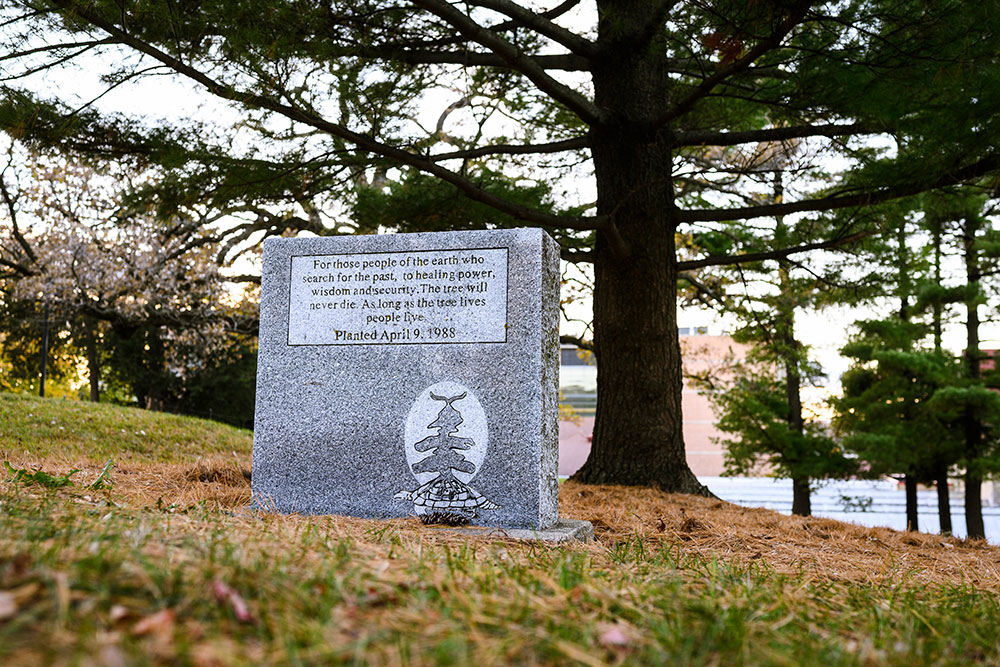
A stone marker details the indigenous meaning of The Tree of Peace – a Native American cultural icon planted in 1988 on Observatory Hill near Washburn Observatory – as the sun sets over Observatory Hill at the UW during autumn on Nov. 2, 2021. The Tree of Peace stands near two visible effigy burial mounds, which were part of a larger mound group created over one thousand years ago. The UW campus is located on ancestral lands of the Ho-Chunk Nation, on what they call Teejop (day-Jope), the Four Lakes. (Photo by Jeff Miller/UW-Madison.)
The University of Wisconsin occupies ancestral Ho-Chunk land, a place their nation has called Teejop (day-JOPE) since time immemorial.
In an 1832 treaty, the Ho-Chunk were forced to cede this territory. Decades of ethnic cleansing followed when both the federal and state government repeatedly, but unsuccessfully, sought to forcibly remove the Ho-Chunk from Wisconsin.
We acknowledge the circumstances that led to the forced removal of the Ho-Chunk people and honor their legacy of resistance and resilience. This history of colonization informs our work and vision for a collaborative future.
We recognize and respect the inherent sovereignty of the Ho-Chunk Nation and the other 11 First Nations within the boundaries of the state of Wisconsin.
Together as an academic health system, we recognize this place and more importantly, move beyond acknowledgment and pledge to continue learning more and taking action.