
 The Madison Family Medicine Residency Program is committed to the personal and professional growth of each of its residents. That growth is fostered by a dynamic curriculum and nurtured by a supportive community of residents, faculty, and staff.
Founded on the principle that graduates should be prepared to practice anywhere—whether rural, urban, or somewhere in between—our program fulfills this vision through an extensive curriculum. Residents receive comprehensive inpatient training, high volume obstetrics, elective and procedural experiences, community health opportunities, and a strong foundation in outpatient care. Our graduates are well equipped to serve all patients in a wide range of clinical settings.
More videos at our YouTube Channel »
Madison Residency Mission Statement
- Cultivates physician leaders from a variety of backgrounds by fostering professional and personal growth
- Teaches full-spectrum family medicine and community health with evidence-based, collaborative and innovative approaches
- Serves the health care needs of patient populations in Wisconsin and beyond
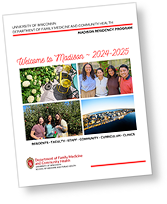
Curriculum
Our curriculum offers robust experiences in obstetrics, inpatient medicine, and pediatrics, as well as numerous electives. Continuity clinics provide residents with a dedicated patient panel for three full years.
Continuity of care is central to our training. Residents are paired with one of four family medicine clinics in the Madison area for the entirety of their residency—each serving a unique patient population.
- At Wingra Clinic, a Federally Qualified Health Center (FQHC), the focus is on underserved and multilingual communities in South Madison.
- The Northport Drive Clinic serves a socioeconomically diverse urban population on Madison’s north side, with a strong commitment to community-based care.
- The Verona Clinic cares for a growing suburban community in the backyard of Epic Systems, emphasizing team-based care and continuity.
- The Belleville Clinic, located just outside Madison, offers a small-town practice environment with exposure to rural family medicine.
Across all sites, residents manage their own patient panels throughout the full three years of training.
Two residents per class are selected for the Rural Health Equity Track at the Belleville Clinic, a longitudinal pathway that offers immersive rural training experiences to prepare graduates to meet the needs of rural communities across Wisconsin and beyond.
The program is also proud to hold Osteopathic Recognition. Our curriculum supports osteopathic residents through focused development of osteopathic manipulation therapy skills, integration of OMT across inpatient and outpatient settings, and dedicated time to provide hands-on osteopathic care in both continuity clinics and hospital settings. We also offer OMT training for allopathic residents through resident seminars and a longitudinal elective called OMT4MD.
Serving Our Community
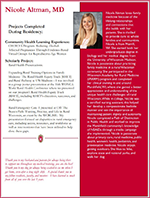 Part of what makes the Madison Family Medicine Residency Program who we are is our strong connection to the community we live in. The 2026 Senior Book showcases scholarly and community medicine projects from our most recent graduating class.
Our commitment to community health runs deep. We were one of the first family medicine departments in the nation to establish an Office of Community Health, reflecting our long-standing dedication to addressing health needs beyond clinic walls and preparing residents to make a meaningful impact in the communities they serve.
Qualities of a Strong Applicant
We are looking for residents who are passionate about primary care, eager to learn and grow, and ready for training in full-spectrum family medicine with strong outpatient, inpatient, obstetrics, and community health training. Additionally, we seek applicants eager to provide care to meet the needs of our patient populations and to help create healthy communities. We work at three hospitals and in a variety of outpatient settings, so teamwork, collaboration, and adaptability are key.
We seek applicants who have at least two years of clinical experience in the United States, including work in inpatient medicine. Just as important, we value candidates who demonstrate a strong commitment to serving their communities and who have excelled academically.
Benefits
We are pleased to offer a generous and competitive benefit package for residents in our program. As employees of the University of Wisconsin School of Medicine and Public Health, our residents enjoy comprehensive benefits that support their health, well-being, and professional growth throughout their training.
Contact
Follow Us
Eligibility
To apply to our program, applicants must have:
- Passed USMLE or COMLEX Step 1 and Step 2 (or Level 1 and Level 2) within two attempts and within the last two years
- Graduated from medical school within the past two years
- At least two years of direct clinical experience in the U.S. or Canada (excluding research or observerships)
Program Size
48 residents (16 per year)
City Size
280, 305 (910,246 metro area)
Program Highlights
Multiple clinical sites, Osteopathic Recognition, and the unique blend of training at a community hospital with access to the University of Wisconsin Hospital and Clinics.
Community Highlights
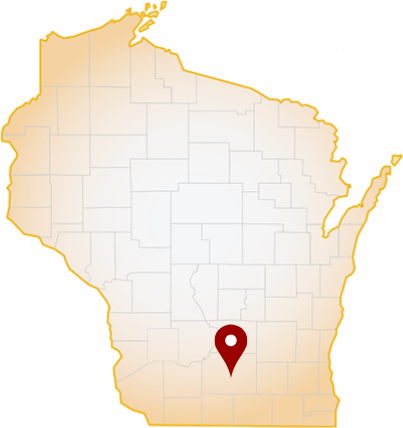
Big-city perks with a small-town feel. Madison is Wisconsin’s state capital and home to the University of Wisconsin–Madison. Known as the City of Lakes, it boasts a lively cultural scene, countless recreational opportunities, and a food scene that punches well above its weight.
Practice Setting
Urban, suburban, rural